

Variance, explained.
Variance is the average squared distance from the mean, for a sample or a population; the page gives it as an exact fraction with the working.
By Suraj Kumar2 min read
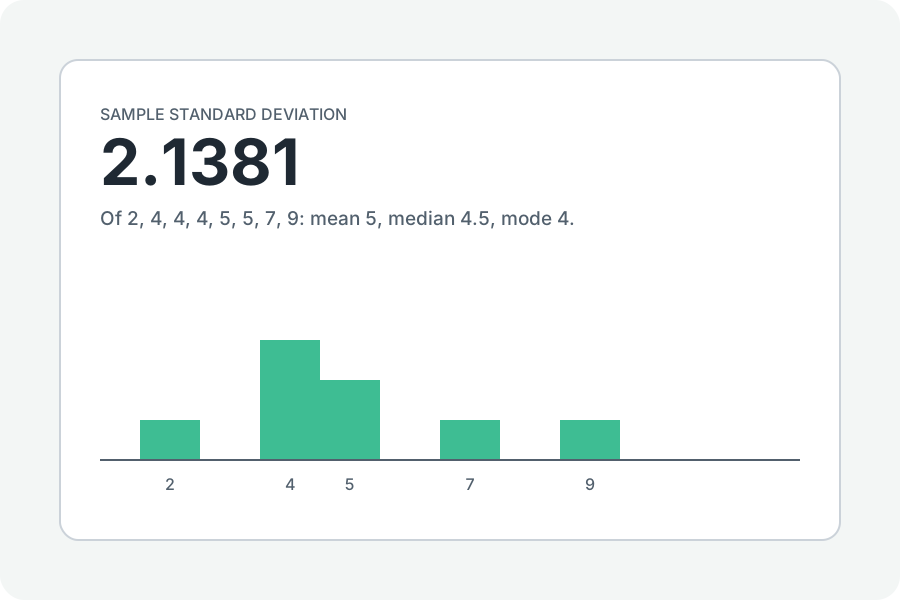
Variance is the standard deviation before its square root.
The sum.
Σ(x − mean)² divided by n − 1 for a sample or n for a population. For 2, 4, 4, 4, 5, 5, 7, 9 the squares add to 32: a sample variance of 32/7 and a population variance of 4.
Exact.
The variance is an exact fraction; only the standard deviation, a square root, is rounded.
Its units.
Variance is in squared units, which is why the standard deviation is easier to read.
Further reading
Topics: variance calculator · how to calculate variance · sample variance · population variance · variance formula
A little less theory. A little more doing.
Try it on your own terms, with a free browser tool.
Try the tool