

A CAD model, ready for the web.
Turn a STEP or STP file into a GLB in your browser, nothing uploaded: its parts, names and colours kept, in metres, checked before you download it.
By Suraj Kumar4 min read
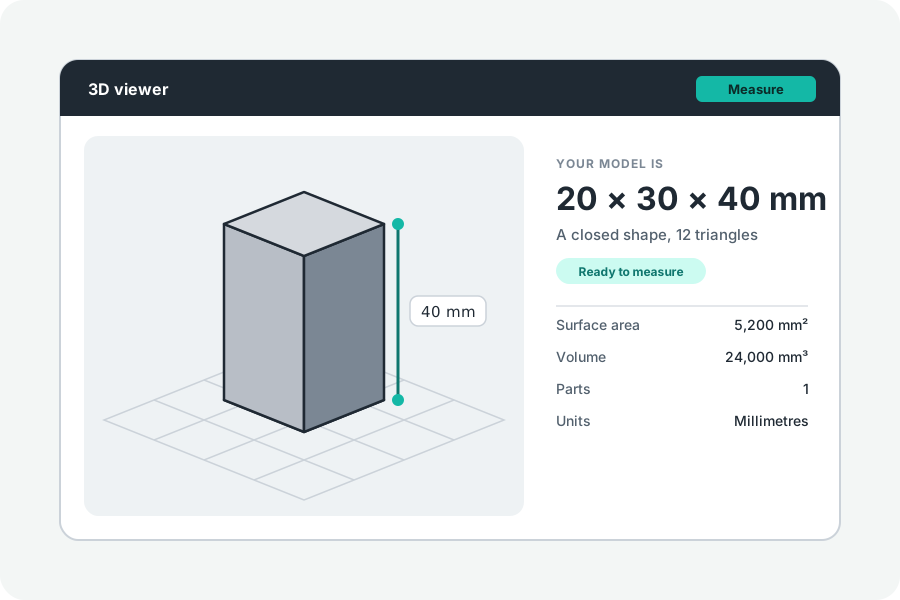
A product page, a configurator or an Android phone's AR shows GLB, not STEP. KeepSimp turns one into the other in your browser, keeping the assembly's parts as they were named.
Drop the STEP.
Open STEP to GLB and drop the file; GLB is already chosen. OCCT cuts its curves into triangles at the detail you choose, and the GLB is written from them, each part a node with its own name and colour.
A STEP keeps exact curves, and a screen or a printer needs flat triangles, so the curves are cut into them. Fine suits most parts; Very fine follows curves more closely and makes a larger file; Draft is quicker and coarser. Measured on a 20 × 30 × 40 mm block with a 10 mm hole, the triangles held 0.22 % more volume than the exact solid at Draft, 0.059 % at Fine and 0.012 % at Very fine.
In metres, standing up.
glTF measures in metres and stands models on Y, while CAD works in millimetres on Z. The GLB is sized and turned as a whole, never mirrored, so a 40 mm part is 0.04 m tall in it.
Before the file is offered, KeepSimp opens it again with its own reader and measures it; a file that does not match the model is not offered, and the page says what was wrong.
On a phone.
Android shows a GLB in AR. For an iPhone or iPad, choose USDZ, which AR Quick Look opens.
Further reading
Topics: step to glb · stp to glb · step to gltf · convert step to glb · cad to glb
A little less theory. A little more doing.
Try it on your own terms, with a free browser tool.
Try the tool