

How a due date is worked out.
Naegele's 280 days from the last period, how cycle length moves it, and when an early scan's date replaces it under ACOG's Committee Opinion 700.
By Suraj Kumar3 min read
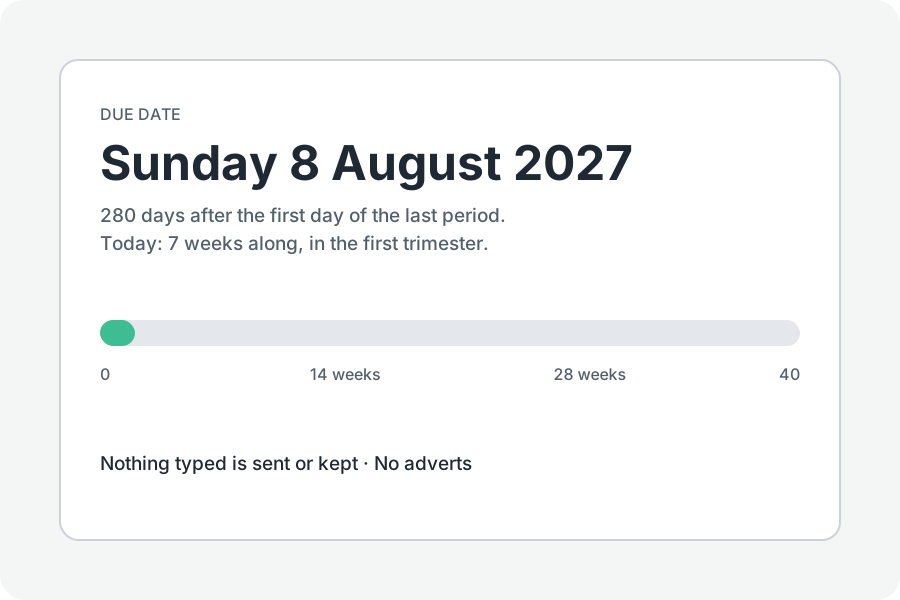
A due date is 40 weeks from the first day of the last period. Here is where that comes from and when a scan changes it.
280 days.
Naegele's rule counts 280 days from the first day of the last period, which assumes ovulation on day 14 of a 28-day cycle. With a longer or shorter usual cycle, the page moves the date by the difference: a 30-day cycle gives a date two days later.
When a scan wins.
ACOG's Committee Opinion 700 says an early scan dates a pregnancy best. Up to 8 weeks and 6 days, the scan's date is used when it differs by more than 5 days; then 7 days to 15 weeks and 6 days, 10 days to 21 weeks and 6 days, and 14 days to 27 weeks and 6 days. The page compares the two under More options.
Only a guide.
A due date is an estimate: babies are born in the weeks around it, and your midwife or doctor will say what to watch for. The date is a middle, not a deadline.
Further reading
Topics: due date calculator · how is due date calculated · naegele's rule · edd · due date by ultrasound
A little less theory. A little more doing.
Try it on your own terms, with a free browser tool.
Try the tool