

Why calculators disagree on 6 ÷ 2(1 + 2).
Why some calculators give 9 for 6 ÷ 2(1 + 2) and others give 1, which rule each follows, and how to write a sum nobody can misread.
By Suraj Kumar4 min read
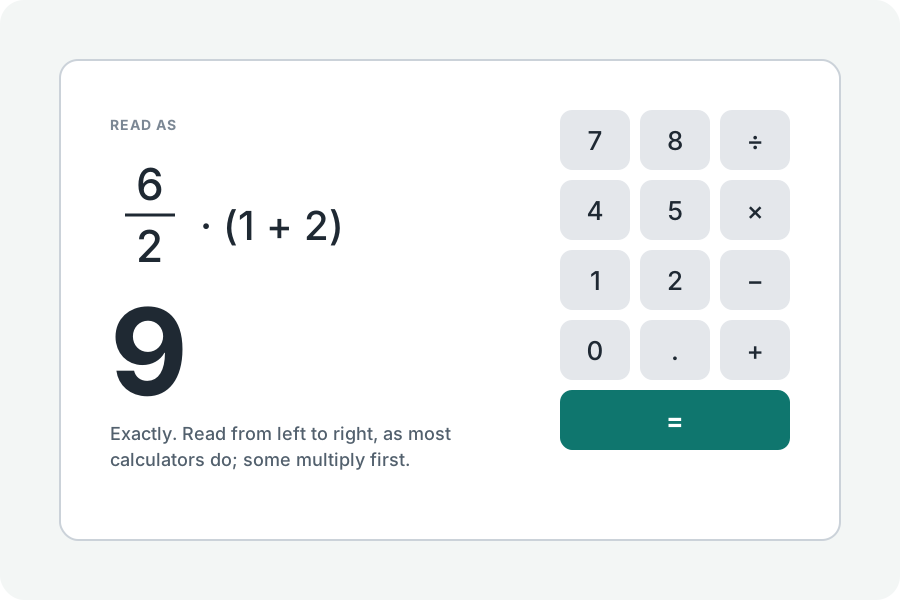
Every few months a sum like 6 ÷ 2(1 + 2) goes round, with half the replies saying 9 and half saying 1. Both camps can point to a calculator that agrees with them. The arithmetic is not in doubt; the question is how the sum is read.
Two readings of the same symbols.
Read from left to right, with the 2 written against the bracket treated like any other ×, the sum is (6 ÷ 2) × (1 + 2) = 3 × 3 = 9. That is how Texas Instruments' current calculators read it, and how maths software such as mathjs reads a number divided by a number and a bracket.
Read with the side-by-side 2(1 + 2) held together first, as some older calculators and many Casio models do, it is 6 ÷ 6 = 1. Neither is a mistake in arithmetic; they are two different rules for a sum written ambiguously.
What KeepSimp's calculator does.
It follows one written rule: things written side by side multiply like ×, worked from left to right, so 6 ÷ 2(1 + 2) is 9. Because the other reading is common, the answer also says so in words and draws the sum as a textbook would, as six over two times one plus two, so you can see how it was read.
It does the same for −2², which it reads as −(2²) = −4, and for a function written without brackets, such as sin 2π, which it reads as sin(2) × π.
Write the sum so nobody can misread it.
Put in the brackets you mean: (6 ÷ 2)(1 + 2) or 6 ÷ (2(1 + 2)). A fraction bar does the same job on paper. When a calculator shows how it read your sum, check that before trusting the answer.
Further reading
Topics: 6/2(1+2) · 6÷2(1+2) · order of operations · implied multiplication · pemdas · bodmas
A little less theory. A little more doing.
Try it on your own terms, with a free browser tool.
Try the tool