

How to add, subtract, multiply and divide fractions.
The steps for adding fractions with a common bottom, multiplying across, dividing by turning over, and writing the answer as a mixed number.
By Suraj Kumar5 min read
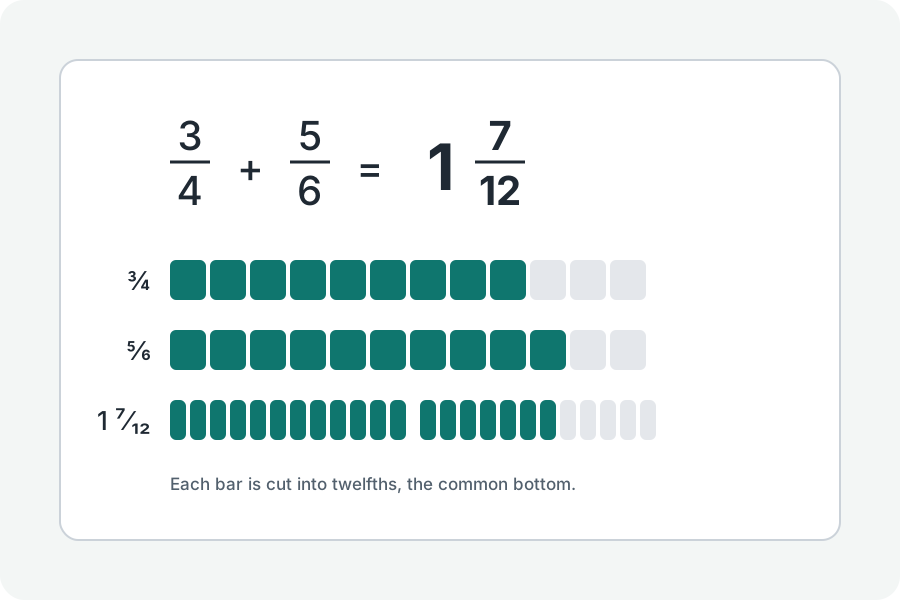
Fractions follow four short rules, one for each operation. Here they are with ¾ and ⅚, the example the Fraction calculator opens with.
Adding and taking away: find a common bottom.
The bottoms must match first. The smallest number both 4 and 6 go into is 12, so ¾ is 9/12 and ⅚ is 10/12. Add the tops and keep the bottom: 19/12, which is 1 and 7/12 as a mixed number.
Multiplying: tops times tops, bottoms times bottoms.
¾ × ⅚ = 15/24, which simplifies to 5/8 by dividing both by 3. Mixed numbers are written as fractions first: 1½ is 3/2.
Dividing: turn the second over and multiply.
¾ ÷ ⅛ is ¾ × 8/1 = 24/4 = 6. The page shows every one of these steps with your fractions, and draws bars cut into the common bottom so you can see the sizes.
Further reading
Topics: how to add fractions · adding fractions · multiplying fractions · dividing fractions · mixed numbers · fraction calculator
A little less theory. A little more doing.
Try it on your own terms, with a free browser tool.
Try the tool