

Balance an equation: the same atoms on both sides.
How to balance a chemical equation so every element matches on both sides, with the smallest whole numbers, ions and electrons, and why some cannot be balanced.
By Suraj Kumar4 min read
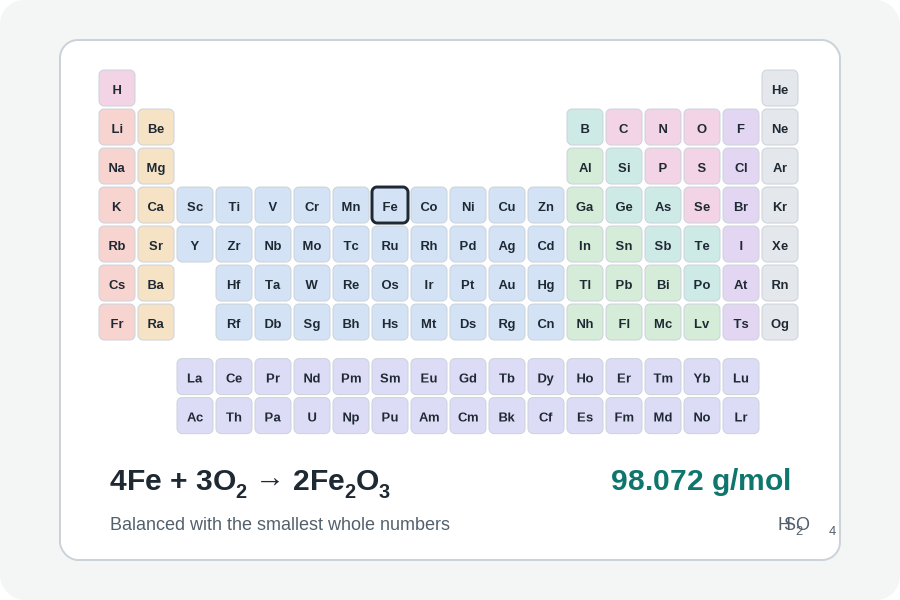
Atoms are not made or lost in a reaction, so a balanced equation has as many of each element on the right as on the left. Balancing means finding how many of each formula take part.
Count each element on both sides.
Take iron rusting: Fe + O2 = Fe2O3. The right holds 2 iron and 3 oxygen atoms, the left 1 and 2. Doubling Fe2O3 gives 4 iron and 6 oxygen, so the left needs 4 Fe and 3 O2: 4Fe + 3O2 → 2Fe2O3. Propane burning comes out as C3H8 + 5O2 → 3CO2 + 4H2O.
The equation balancer does this for any equation and shows a table of each element's atoms on the left and the right, so you can see that every row matches.
Exact numbers, not trial and error.
Each element gives one condition: its atoms on the left equal its atoms on the right. Solving those conditions together, with exact fractions rather than rounded decimals, gives the ratio of the numbers; multiplying out the fractions gives the smallest whole numbers. That is how KeepSimp finds 2 KMnO4 + 16 HCl → 2 KCl + 2 MnCl2 + 8 H2O + 5 Cl2.
Ions balance the same way with the charge as one more condition. Write a charge after ^ (Fe^2+, MnO4^-) and an electron as e-, and half-equations such as Cr2O7^2- + 14H+ + 6e- → 2Cr^3+ + 7H2O come out with the charge equal on both sides.
When there is no single answer.
An element on one side only means a formula is missing or wrong, and the balancer names the element. If only zero of everything balances it, a formula is wrong. If there is more than one independent way, as with H2 + O2 = H2O + H2O2, the equation is really two reactions written as one, and the balancer says so rather than picking one.
Numbers typed in front of formulas are set aside and worked out again, and states such as (aq) and (s) are kept as written.
Further reading
Topics: chemical equation balancer · how to balance chemical equations · balancing equations · stoichiometry · balance redox equations · coefficients
A little less theory. A little more doing.
Try it on your own terms, with a free browser tool.
Try the tool