

Every element, its weight, and the sums that use it.
An interactive periodic table of all 118 elements with IUPAC's 2024 atomic weights, electron configurations and states, plus molar masses and equations.
By Suraj Kumar4 min read
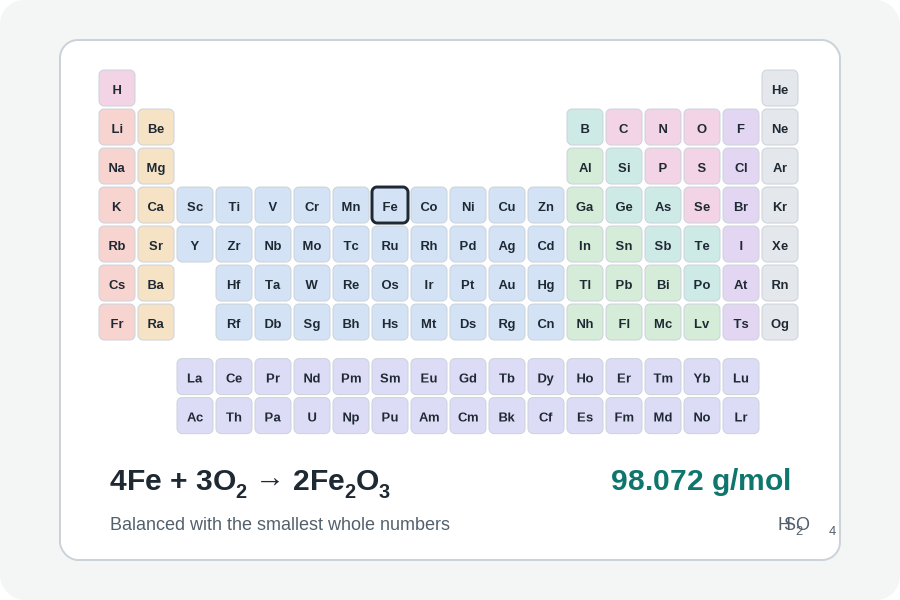
A periodic table is most useful with its numbers to hand. KeepSimp's lays out all 118 elements, says what each one is in words, and does the two sums chemistry homework asks most: a molar mass and a balanced equation.
All 118 elements, by group and period.
The table is drawn the usual way: eighteen groups across, seven periods down, and the lanthanides (57 to 71) and actinides (89 to 103) in two rows below, as IUPAC's own table draws them. On a phone it scrolls sideways inside its own box, or you can show the elements as a list.
Press an element, or type its name, symbol or number, to see its standard atomic weight, group, period, block, kind, electron configuration and state at room temperature. The arrow keys move through the table, and the colours (by kind, block or state) are named in a legend.
Atomic weights from the body that sets them.
The weights are IUPAC CIAAW's abridged standard atomic weights of 2024, read from its table on 24 November 2026, with the ± it gives. Fourteen elements, hydrogen, carbon and oxygen among them, vary a little from sample to sample, and CIAAW's full table gives them as an interval; the abridged table gives a conventional value for everyday use, and the element's details say so.
Technetium, promethium and every element from polonium on except thorium, protactinium and uranium have no standard atomic weight, because none of their isotopes is stable. The table says so rather than printing the mass of one isotope. Electron configurations, states and kinds come from PubChem's periodic table, published by the US National Library of Medicine.
A molar mass, or a balanced equation.
The first question asks what you want to do. Work out a molar mass reads a formula with nested brackets or a hydrate's dot and adds the weights exactly, element by element. Balance an equation finds the smallest whole numbers that make every element match on both sides, and says why when there is no single answer.
Everything is worked out in your browser from data that comes with the page, so it works offline once loaded and nothing you type is sent anywhere.
Further reading
- Abridged Standard Atomic Weights 2024, IUPAC Commission on Isotopic Abundances and Atomic Weights (CIAAW) (opens in a new tab)
- Standard Atomic Weights, IUPAC CIAAW (opens in a new tab)
- Standard atomic weights of the elements 2021 (IUPAC Technical Report), Pure and Applied Chemistry (opens in a new tab)
- Periodic Table of Elements, PubChem (US National Library of Medicine) (opens in a new tab)
Topics: periodic table · interactive periodic table · periodic table with atomic mass · electron configuration · element symbols · standard atomic weight
A little less theory. A little more doing.
Try it on your own terms, with a free browser tool.
Try the tool