

How to work out a percentage off, and why two discounts are not added.
How to take 20% off a price, what you save, and why 20% off and then 10% off comes to 28% off, not 30%. With the steps on your own numbers.
By Suraj Kumar3 min read
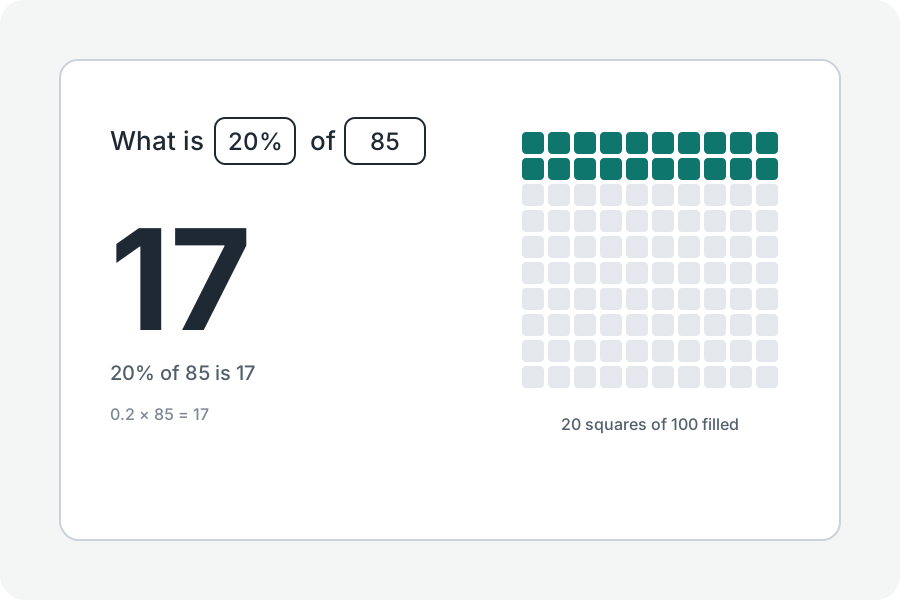
A sale sign says 20% off; the shelf price is 85. Here is the sum, and the catch when a second discount is taken at the till.
Take the percentage off.
20% of 85 is 17, so you pay 85 − 17 = 68. In one step: 85 × 0.8 = 68, since paying 80% is the same as 20% off. The Percent off calculator says what you pay and what you save.
Two discounts in a row.
20% off and then 10% off is not 30% off. The second is taken from the lower price: 100 becomes 80, and 10% of 80 is 8, leaving 72, which is 28% off in all. Put the second discount under More options and the page works it out and says so.
Adding tax or a tip works the same way.
Choose Add instead: 100 plus 18% is 118. To go back from 118 to the price before the tax, divide by 1.18 rather than taking 18% off.
Further reading
Topics: percent off · discount calculator · how to calculate discount · sale price · 20 percent off · stacked discounts
A little less theory. A little more doing.
Try it on your own terms, with a free browser tool.
Try the tool