

What your BMI tells you, and what it does not.
How BMI is worked out, the WHO's bands and the lower cut-offs for Asian populations, the healthy weights for your height, and what BMI cannot see.
By Suraj Kumar3 min read
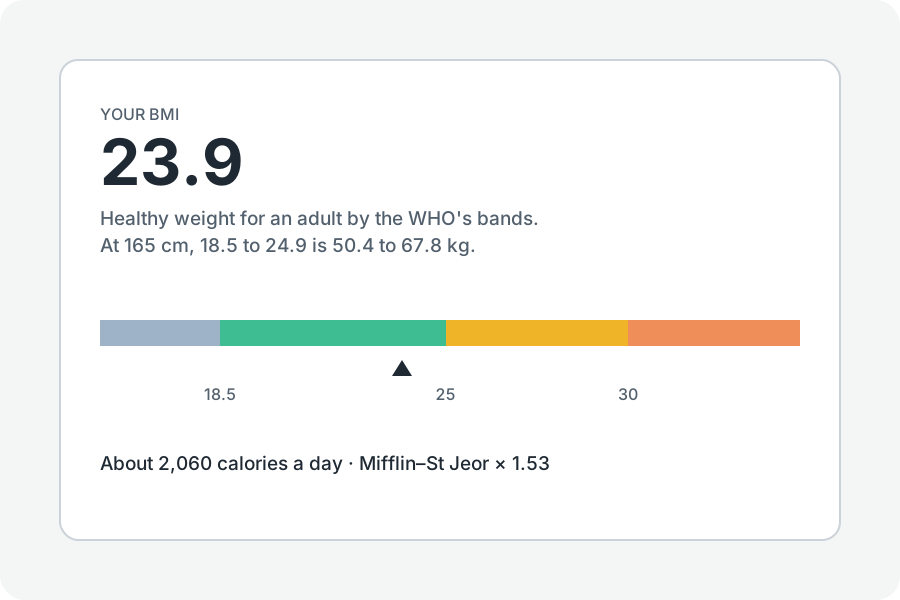
Body mass index is one number from two measures. It is quick and useful for comparing groups, and it misses a great deal about one person.
One sum.
BMI is your weight in kilograms divided by your height in metres squared: 65 kg at 1.65 m is 65 ÷ 2.7225, a BMI of 23.9. In pounds and inches the page turns both into metric units by the exact international pound and inch first, so the answer is the same either way.
The bands.
The WHO calls under 18.5 underweight, 18.5 to 24.9 a healthy weight, 25 to 29.9 overweight and 30 or more obesity, in three classes. A WHO expert consultation in 2004 set lower points for Asian populations, 23 and 27.5, which the page offers under More options. The band is judged on the number as shown, so 24.96, shown as 25.0, is overweight.
What it cannot see.
BMI does not tell muscle from fat or say where fat sits, so a rugby player can read as overweight and an older person with little muscle as healthy. It is a starting point for a talk with a doctor, never a verdict.
Further reading
Topics: bmi calculator · what is a healthy bmi · bmi ranges · bmi chart · healthy weight for my height
A little less theory. A little more doing.
Try it on your own terms, with a free browser tool.
Try the tool