

Why a month is not a fixed number of days, and how dates are added.
Adding a month to 31 January cannot land on 31 February. How the Date calculator adds days, weeks, months and years, and what it does at a month's end.
By Suraj Kumar3 min read
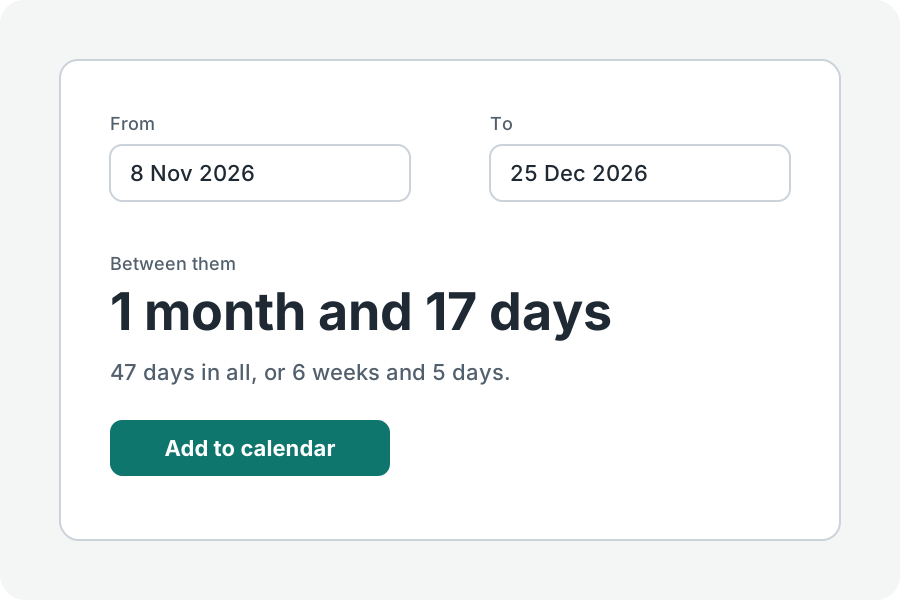
Days and weeks are fixed lengths; months and years are not. Here is what happens when a sum lands on a day a month does not have.
Days and weeks: always the same.
Adding 30 days moves exactly 30 days on the calendar, and the start day is not counted: tomorrow is 1 day after today. Weeks are 7 days each. The answer says the weekday and the week number of the date you land on.
Months: the same day, or the month's last.
Adding a month keeps the day of the month: 15 March plus a month is 15 April. When the month is shorter, the answer is its last day, as calendar programs and the coming JavaScript Temporal standard do: 31 January plus a month is 28 February, or 29 in a leap year. The page says when it has done that.
Adding working days.
Choose Working days to step over weekends and public holidays: 3 working days after Wednesday 23 December 2026, with Christmas Day off, is Tuesday 29 December. The days stepped over are listed.
Further reading
Topics: add days to date · add months to date · date plus days · date calculator add · 90 days from today · 30 days from today
A little less theory. A little more doing.
Try it on your own terms, with a free browser tool.
Try the tool