

How a Hindi typing test is counted, the way SSC counts it.
Practise Hindi typing in your browser, nothing uploaded, and see how SSC counts it: 5 strokes a word, full and half mistakes, net speed and KDPH.
By Suraj Kumar5 min read
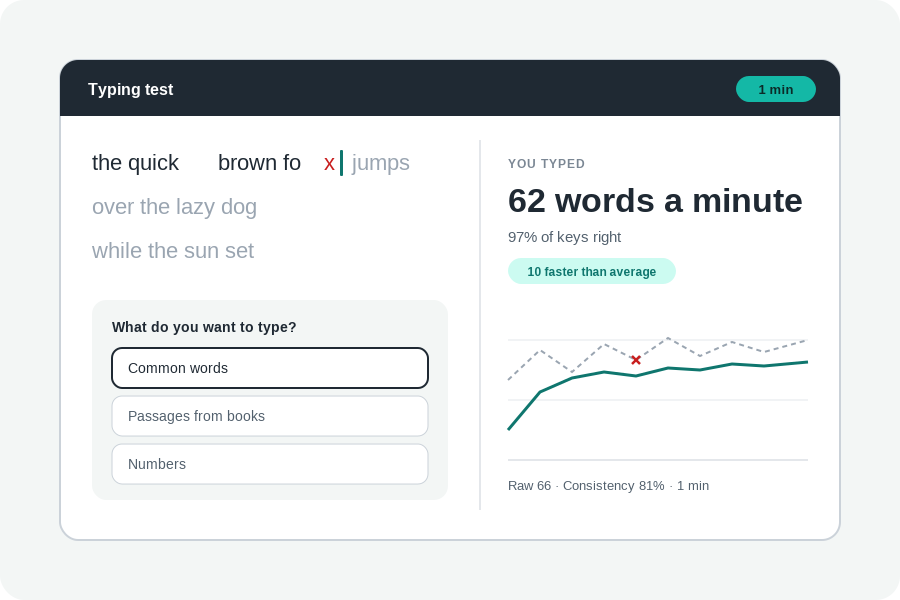
Government typing tests in India ask Hindi typists for 30 words a minute, and they count those words in their own way: by key depressions, with mistakes taken off as strokes. KeepSimp's Hindi typing test gives you that count beside its usual one, worked out in your browser from what you typed. Here is the rule, where it comes from, and what a web page can and cannot measure.
A word is five key depressions.
Exams do not count Hindi words as you see them. They count strokes, the key depressions it took, and call every five strokes a word. That is why notices say 30 words a minute in Hindi is 9,000 key depressions an hour: 30 × 5 × 60.
A web page cannot see your keys, only what they put in the field. So KeepSimp counts a stroke as one Unicode character of what you left typed: a letter, a matra, a halant or a space. On InScript that is one key each. Remington and phonetic keyboards can take more or fewer keys for the same letters, so the page says so beside the number.
Full mistakes and half mistakes.
SSC's guidelines, which other bodies such as AIIMS reproduce, call a word left out, put in or spelt wrong a full mistake. A wrong or missing matra counts too, but a word is never more than one full mistake. Punctuation and spacing errors are half mistakes. Capital letters do not apply to Hindi, and correct alternate spellings that come from fonts and keyboards are not mistakes.
KeepSimp judges each word you moved on from. A word whose letters are right but whose punctuation is not is a half mistake; any other wrong word is a full one. हिंदी and हिन्दी are two correct ways of writing the same word, so neither is a mistake. The word cut off by the clock is not judged.
Each mistake costs 50 strokes.
The total of mistakes is the full ones plus half the half ones, not rounded. Each takes 50 strokes off. Net words a minute is the strokes left over five, over the minutes, and key depressions an hour is the strokes left times 60 over the minutes. SSC's own example: 3,000 strokes with 20 mistakes in 10 minutes is 2,000 strokes, or 40 words a minute.
Accuracy, by this rule, is net speed over gross speed. A test with too few strokes for the speed asked, 30 words a minute × 5 × the minutes, is an insufficient attempt and is not checked. KeepSimp says when that is so. CPCT, high courts and state boards have rules of their own, so check your exam's notice.
Practise on passages, in Unicode.
The Hindi typing test opens on passages from books in the public domain by Premchand and Jaishankar Prasad, ten minutes long as SSC's test is. Older books keep their spellings, and the test asks for them as written, as exams do.
Exams use Unicode Hindi, the Mangal font on an InScript or Remington GAIL keyboard. Kruti Dev and other old fonts are not Unicode: they type English letters drawn as Hindi, so they are not read as Hindi here. Everything happens in your browser; nothing you type is sent anywhere.
Further reading
- Evaluation criteria for typing and data entry speed tests (SSC's guidelines), as reproduced in AIIMS's Scheme of Skill Test, CRE-2024 (opens in a new tab)
- CSIR-CBRI advertisement, 2025: 30 words a minute in Hindi is 9,000 key depressions an hour (opens in a new tab)
- The Unicode Standard, Devanagari code chart (opens in a new tab)
Topics: hindi typing test · ssc hindi typing test · hindi typing speed · key depressions per hour · full mistake half mistake · mangal hindi typing · net wpm hindi
A little less theory. A little more doing.
Try it on your own terms, with a free browser tool.
Try the tool