

How a loan payment (EMI) is worked out.
The EMI formula, P·r·(1+r)^n / ((1+r)^n − 1), explained with ₹10 lakh at 8.5% over 20 years, and why the last instalment can differ by a few rupees.
By Suraj Kumar3 min read
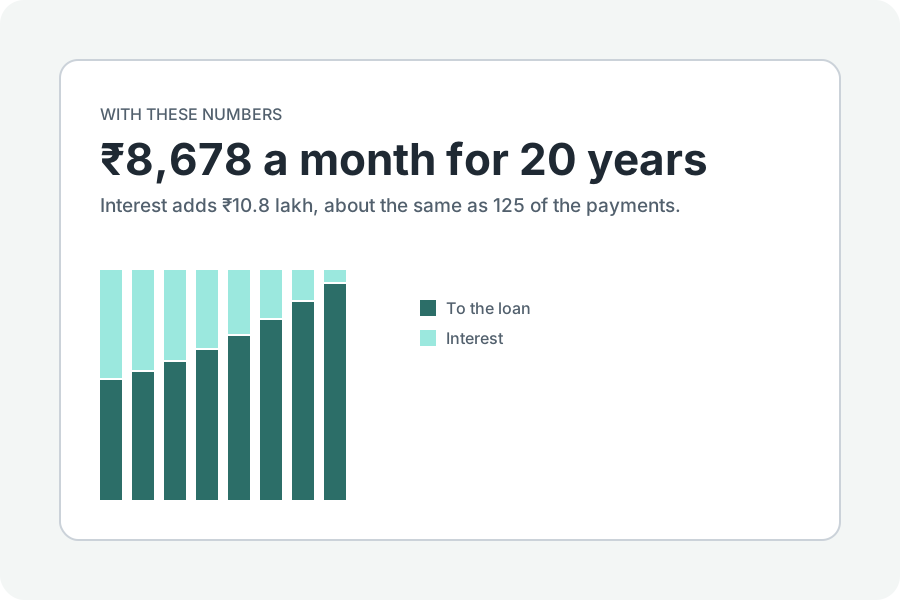
An EMI is the one steady payment that pays a loan off exactly by its last month. Here is the formula and an example.
The formula.
With P the amount, r the yearly rate divided by 12, and n the number of months, the EMI is P·r·(1+r)^n / ((1+r)^n − 1), the same as a spreadsheet's PMT. At no interest it is simply P divided by n.
An example.
₹10,00,000 at 8.5% for 240 months gives ₹8,678.23 a month. Early on most of it is interest; by the end almost all of it pays the loan down.
The last instalment.
Each month's interest is rounded to the paisa, so a few paise build up; the last instalment pays exactly what is left, here ₹8,679.66.
Further reading
Topics: emi calculator · emi formula · how emi is calculated · emi calculation · loan emi
A little less theory. A little more doing.
Try it on your own terms, with a free browser tool.
Try the tool