

A natural voice that reads to you, on your device.
Turn text into natural speech in your browser with Kokoro, an open voice model: listen while it is made, then save it as MP3 or WAV with subtitles.
By Suraj Kumar4 min read
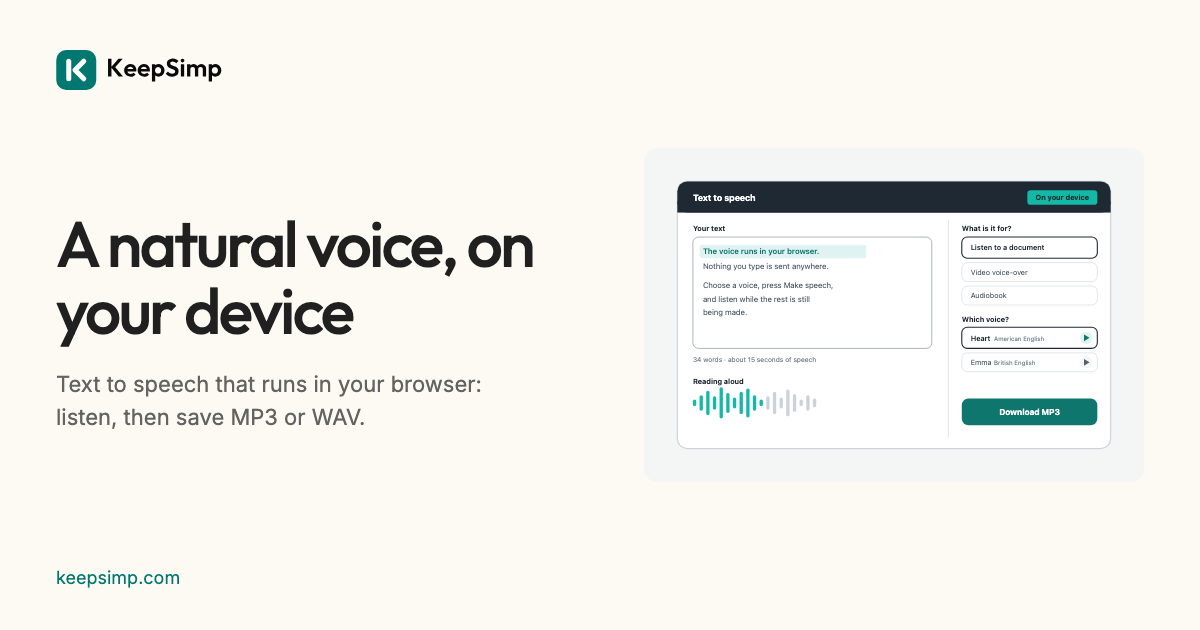
Most text-to-speech sites send your text to a server, count your characters, and ask for an account before the good voices. Text to speech on KeepSimp runs the voice in your browser instead: Kokoro, an open model of 82 million parameters released under the Apache 2.0 licence, small enough to run on a laptop or a recent phone.
Paste, choose, listen.
Type or paste your text, or open a text, Markdown or Word file. Under the box you see how many words it has and about how long it will take to say. Then answer one question, what it is for: Listen to a document reads a little quicker than talking pace; Video voice-over reads at talking pace, evens the loudness and adds subtitles; Audiobook leaves longer pauses between paragraphs and writes a chapter for each heading.
Choose one of nine voices, six with an American accent and three with a British one, and press the play button beside any of them to hear it say a sentence first. Press Make speech and it starts reading at once, while the rest is still being made; Stop halts it within a sentence.
MP3, WAV and subtitles.
When it is ready, the page says how long it came to, how many words and which voice, and Download saves it. The MP3 is written by the same writer as the site's audio tools, with LAME and a gapless header, and opened again and checked before it is offered; WAV is 16-bit and lossless. Subtitles come as SRT or WebVTT, each sentence at its exact time, at most two lines of 42 letters and seven seconds each.
For a video, the voice-over is measured as broadcasters measure loudness (ITU-R BS.1770) and set to −16 LUFS, the level Apple Podcasts asks of spoken word. For an audiobook, each heading of a Markdown or Word file becomes an ID3 chapter in the MP3.
How the voice works.
Your text is cut into sentences, and numbers, money, times and abbreviations are written out as they are said (the rules come from kokoro-js, Kokoro's own JavaScript library). eSpeak NG turns each sentence into the sounds of English, and Kokoro speaks them in the voice you chose. A sentence too long for the model in one go is spoken in pieces, split at a comma or between words, so nothing is ever cut off.
It is a computer-made voice. It can mispronounce names, numbers and abbreviations, so listen before you publish. It reads English only for now, it has no pitch setting, and it cannot copy anyone's voice.
Your text stays on your device.
The voice runs in your browser: what you type or open is never sent anywhere. The first time, the voice's files (about 120 MB) are downloaded from KeepSimp itself, never from another site, and your browser keeps them, so it works offline after that. Nothing you make is kept when you leave the page.
Further reading
- Kokoro-82M, the model and its voices (Apache 2.0) (opens in a new tab)
- Kokoro's voices and their grades (opens in a new tab)
- kokoro-js, Kokoro's JavaScript library (opens in a new tab)
- eSpeak NG, which turns words into sounds (opens in a new tab)
- Apple Podcasts: audio requirements (opens in a new tab)
- ITU-R BS.1770: measuring loudness (opens in a new tab)
Topics: text to speech · natural text to speech · free tts · text to speech free unlimited · text to speech no sign up · text to speech mp3 download · read text aloud · ai voice generator · voice over · kokoro tts
A little less theory. A little more doing.
Try it on your own terms, with a free browser tool.
Try the tool