

What is really in a string.
See each character's code point, name and UTF-8 bytes, write escapes for your language, normalise text, and find hidden and look-alike characters.
By Suraj KumarUpdated 4 min read
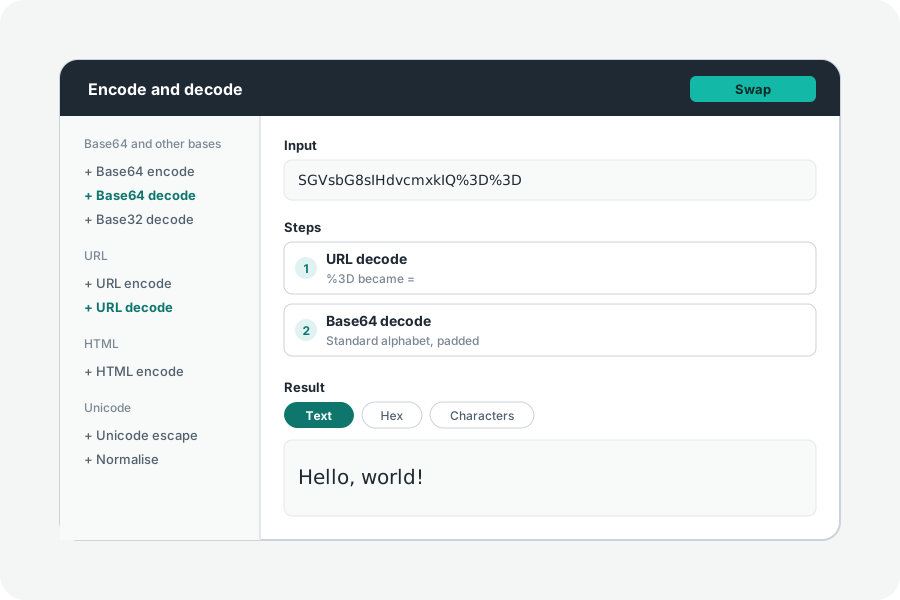
Two strings that look the same can differ: é stored as one character or as two, a zero-width space in a password, a Cyrillic letter in a domain. The Unicode converter shows what each character is.
Every character, by name.
Open the Unicode converter and paste text, then choose Characters: each one is listed with its code point, its name from Unicode 17.0, its category and script, and its bytes in UTF-8 and UTF-16. The count says how many characters, UTF-8 bytes and UTF-16 units it has (what JavaScript's length counts).
Escapes for your language.
Write text as the escapes JavaScript, JSON and Java use (\u00E9, with a surrogate pair beyond the first 65,536 characters), as Rust and modern JavaScript write them (\u{1F600}), as Python, C, CSS or HTML do, or as UTF-8 bytes. Unicode unescape reads any of them back.
Nothing leaves your browser.
Everything is worked out on your device: what you paste or open is never sent anywhere, and nothing is kept when you leave. A share link carries what you typed after the #, which browsers never send to a server.
Further reading
Topics: unicode converter · code point · utf-8 bytes · unicode escape · zero width space · homoglyph · unicode normalization · punycode
A little less theory. A little more doing.
Try it on your own terms, with a free browser tool.
Try the tool