

How time zones and clock changes work, and where they trip people up.
Why some places are half an hour apart, why the gap between two cities changes twice a year, and how the World clock shows each place's time and daylight.
By Suraj Kumar4 min read
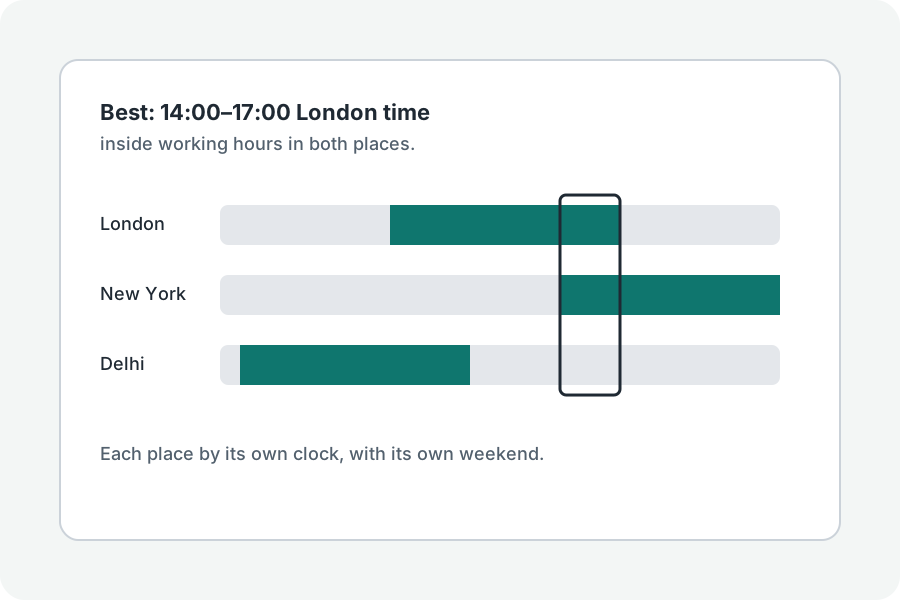
A time zone is a place's agreed offset from UTC, and the rules for changing it twice a year. Both are set by governments, and both change.
Offsets, whole and not.
Most places are a whole number of hours from UTC, but India is 5½ hours ahead, Nepal 5¾ and New Zealand's Chatham Islands 12¾ in winter. The World clock shows each place's offset from UTC and from you, and whether it is already tomorrow there.
Clocks that change, and those that do not.
The US and Canada move their clocks on different weekends from Europe, and the southern hemisphere moves the other way, so the gap between two cities changes several times a year. Each clock on the page says when its clocks next change, within the next two months. A meeting planned across that weekend shows the new gap.
Where the rules come from.
Every browser carries IANA's time-zone database, and the page uses your browser's copy. When a government changes its rules at short notice, as Cuba did for this winter, browsers take weeks to catch up; the page warns where it knows of such a change. Day and night are worked out from each place's position and the Sun's, with no data sent anywhere.
Further reading
Topics: world clock · time zones · daylight saving time · current time · time around the world · world time
A little less theory. A little more doing.
Try it on your own terms, with a free browser tool.
Try the tool