

Ask your agent for the animation.
Have an AI agent turn Lottie and .riv files into videos, animate SVGs and 3D models on your own computer, nothing uploaded, every file checked first.
By Suraj Kumar6 min read
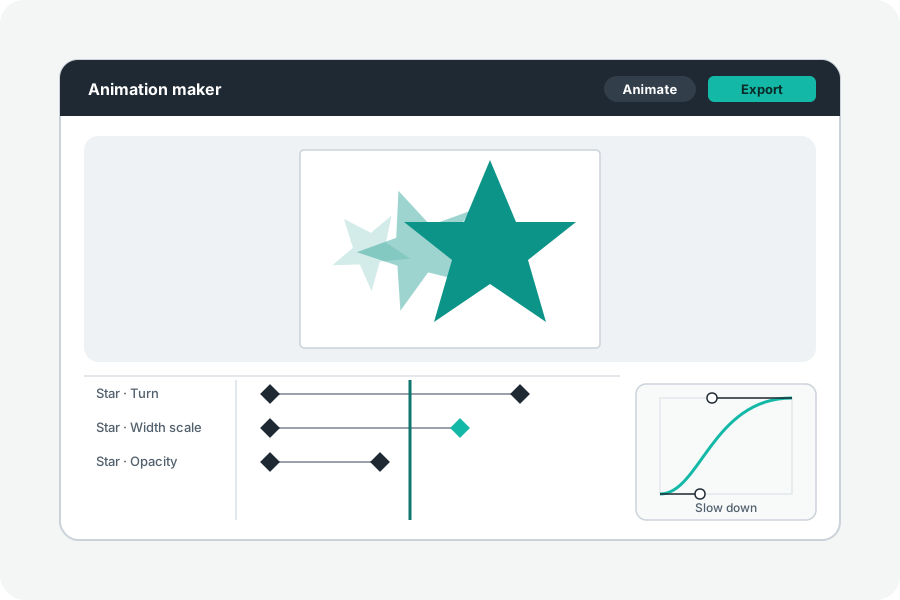
Turning forty Lottie files into GIFs, or every logo in a folder into a short video, is an afternoon by hand. An agent such as Claude Code or Codex can do it with KeepSimp's Animation maker tools, which run on your computer with the same code as the editor's own Export. Every file is checked before it is handed back, and nothing is uploaded.
Four tools for animation.
Convert a Lottie (convert_lottie), make a video of a .riv (render_riv), animate an SVG drawing (make_animation_from_svg) and animate a 3D model (animate_model). An agent finds them with KeepSimp's other tools, and you ask for what you want in plain words.
Turn every .tgs in stickers/ into a GIF on white.

Make an MP4 of button.riv: run its state machine for
4 seconds and fire the Press trigger at 1 second.

Give logo.svg a pop-in, part by part, and save it as
a Lottie and as a GIF.

Make a GLB of chair.glb turning round twice in 6 seconds.
A Lottie, a .lottie or a sticker, to a video.
A Lottie JSON, a dotLottie or a Telegram .tgs becomes an MP4, a WebM, a GIF, an animated WebP or APNG, a PNG of one frame, or an animated SVG that plays with no script. Its frames are drawn by ThorVG, the player KeepSimp's Lottie viewer uses, over a colour or clear, once ThorVG has found every frame the file says it has. A dotLottie that holds several animations plays the one named.
An animated SVG is the Lottie read into the editor and written by it; what the editor cannot hold, such as expressions and text layers, is left out and said.
A .riv, played as it would play.
A .riv is played by Rive's own runtime. Asked first, the tool says what the file holds: its artboards, its animations with their lengths, and its state machines with their inputs. An animation plays one pass; a state machine runs for the seconds asked (three when left out), its switches and numbers set by name at the start and its triggers fired at the moments asked.
A name that is not in the file is refused, with the names that are, so the agent can try again. The result is an MP4, a WebM, a GIF, an animated WebP or APNG, or a PNG of one moment.
An SVG, given a ready motion.
An SVG is opened as the editor's first screen opens one and given one of six motions: pop in with a little overshoot, fade in, slide in from a side, spin once round, pulse, or wiggle. It moves as a whole, or part by part a moment apart; a drawing kept in one group is taken apart into that group's parts.
The motion is made only of the editor's own keys, so the project can be opened in the editor and changed by hand. It is saved as a video, a GIF, a WebP or APNG, a Lottie, a dotLottie, a .riv, an animated SVG or a project. A drawing with no background is put on white for an MP4, a WebM or a GIF, and the answer says so.
A 3D model, turned or keyed.
Any model KeepSimp's 3D viewer opens (GLB, glTF, FBX, OBJ, STL, STEP and the others) is placed in a new 3D scene with the camera turned to frame it. It can turn round like a turntable about an axis, or its parts, the whole model and the camera can be given keys by name. A model whose middle is off the axis is turned about its middle, and the answer says so.
The model's own animations are kept, one is chosen to play, or all are left out. It is saved as an animated GLB or as a video or GIF of the camera's view.
How an agent reaches them.
Desktop agents such as Claude Code and Codex speak the Model Context Protocol. KeepSimp's bridge, keepsimp-mcp on npm, opens KeepSimp's agent page in a hidden browser on your computer, hands it the files your agent names, and saves what it made in the folder asked for or beside the first file, never over an existing file. It reads and writes only inside the folders your agent works in.
In Claude Code, add it with: claude mcp add keepsimp -- npx -y keepsimp-mcp. An agent in Chrome can reach the same tools on the agent page through WebMCP, a proposed standard that Chrome is trying out.
What is checked, and what stays home.
Every file is made by the same code as the editor's Export and read back before it is handed over. Videos, GIFs, WebPs and APNGs are written and checked by KeepSimp's Animation converter, at the size planned. A Lottie is checked against the Lottie schema and played by ThorVG against the editor's own frames; a .riv is opened by Rive's runtime and held to the editor; an SVG is opened again by the browser; an animated GLB is loaded as the 3D viewer loads one.
A moving picture lasts at most 60 seconds, with sides of 16 to 4,096 pixels, as Export allows. Files stay on your device the whole time: the bridge's browser opens only the KeepSimp site and refuses every other address.
Further reading
- What is the Model Context Protocol (MCP)? (opens in a new tab)
- Chrome for Developers: WebMCP imperative API (opens in a new tab)
- npm: keepsimp-mcp (opens in a new tab)
- Lottie Animation Format, Lottie Animation Community (opens in a new tab)
- ThorVG, Thor Vector Graphics (opens in a new tab)
- Rive: Getting started with the Rive runtimes (opens in a new tab)
- glTF Validator, Khronos Group (opens in a new tab)
Topics: batch convert lottie to gif · convert lottie to mp4 automatically · riv to video · animate svg automatically · tgs to gif batch · glb turntable animation · mcp animation tools
A little less theory. A little more doing.
Try it on your own terms, with a free browser tool.
Try the tool