

Lock a ZIP with a password, and know what it hides.
Lock a ZIP with a password in your browser, with nothing uploaded: AES-256 or ZipCrypto, what opens each, and what a password does not hide.
By Suraj Kumar5 min read
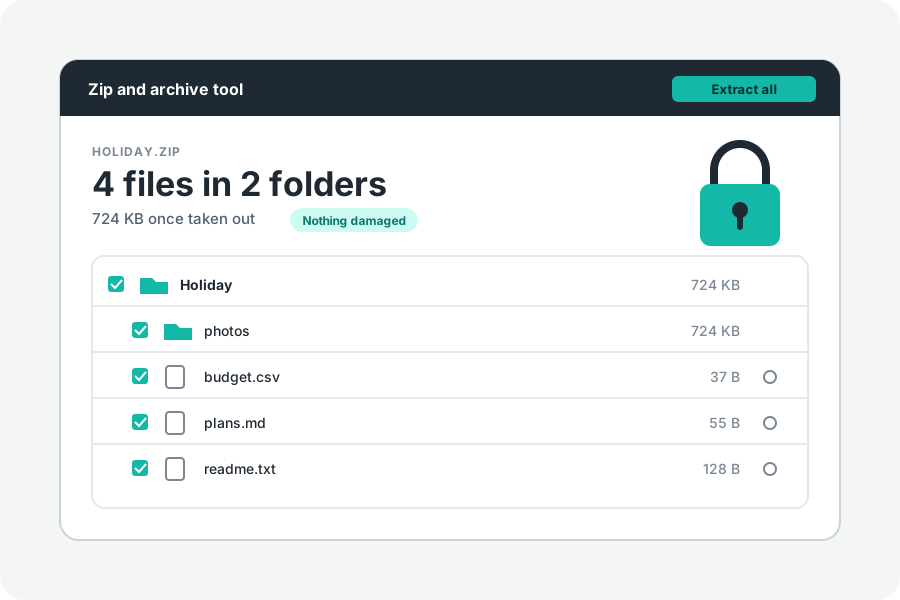
A password on a ZIP keeps what is in its files from anyone who does not have it. There are two kinds of lock, though, and they differ in how strong they are and in what will open them. Here is how to make one in your browser and which to choose.
Make the locked ZIP.
Open Password protect a ZIP and drop files or folders on it. Type a password, then type it again, so a slip of a finger does not lock you out. Then press Make the locked ZIP.
Everything happens in your browser. The files and the password are never sent anywhere, and the ZIP is written on your device.
AES-256: strong, opened by fewer programs.
AES-256 is the lock the page uses unless you choose otherwise. It follows WinZip's AES specification, which 7-Zip, WinZip, WinRAR and Keka read. A long password that is hard to guess makes it, in practice, impossible to open without it.
The programs built into computers often cannot open it. Microsoft's help says Windows does not support operations on encrypted archives and points to programs such as 7-Zip or WinRAR. In our tests, the Mac's Archive Utility and the unzip that comes with macOS did not open AES-256, and nor does Python's zipfile. Before you send one, make sure the person has such a program; the Zip and archive tool opens it in any browser too.
ZipCrypto: opens almost everywhere, easily broken.
ZipCrypto is the original ZIP password. Almost every program opens it, File Explorer often included. It is weak: a known-plaintext attack against it was published in 1994. It keeps a file from a casual glance, not from someone determined to read it.
Choose it under More options, in Kind of lock, when the person can only use what their computer came with. Letters outside English in a ZipCrypto password are written as UTF-8, as today's programs read them; plain letters and digits are safest for old ones.
The password is never kept.
The password stays in its field while the page is open and is used only to make the ZIP. It is not saved in the browser or anywhere else, and KeepSimp has no copy. If it is lost, the files cannot be got back, by you or by anyone.
Send the password another way than the ZIP: tell it, text it, or send it in a separate message, so that one lost email does not give away both.
Further reading
- AES encryption information: encryption specification AE-1 and AE-2, WinZip (opens in a new tab)
- A known plaintext attack on the PKZIP stream cipher, Biham and Kocher (1994) (opens in a new tab)
- APPNOTE.TXT: the .ZIP file format specification, PKWARE (opens in a new tab)
- Zip and unzip files, Microsoft Support (opens in a new tab)
Topics: password protect zip · encrypt zip file · zip with password · aes-256 zip · zipcrypto · lock zip file · secure zip · zip password mac
A little less theory. A little more doing.
Try it on your own terms, with a free browser tool.
Try the tool